
Why can’t the clothes just clean themselves? It’s a fair question, and I don’t have a good answer.
Laundry never stays done. Nobody applauds when you finish. There’s no real deadline either, until you run out of socks, and then the deadline arrives all at once. And it can eat an afternoon, most of which is spent waiting on a machine.
What I do have is a better question than “why can’t I just do it?” The better question is: what is actually happening in my head when I don’t?
Boring plus fuzzy deadline equals nothing happens
Laundry is the perfect example of what stalls many people with ADHD. It’s boring, and the deadline isn’t real. Many people with ADHD operate in two time zones: now and not now. If something is urgent and in your face, it’s now, and it gets done. If it isn’t, it’s not now, and not now can last for weeks. A pile of laundry sits firmly in not now until the clean clothes run out.
Here’s the cruel part. Starting a load takes about five minutes. It feels like a boulder.
Many ADHD coaches describe the ADHD brain as running on interest, novelty, challenge and urgency more than on importance. I find that a useful way to make sense of the pattern, though I’d call it a framework, not a proven mechanism. Under that lens, a boring task with a vague deadline offers the brain nothing to grab. “I should” doesn’t turn into “I’m doing it.” That isn’t laziness. It’s a mismatch between what the task offers and what your brain needs to get started.
Avoidance is a very efficient bad idea
Avoidance works, which is the whole problem. It goes like this:
The task shows up and feels boring, or like one more thing.
A small flash of discomfort arrives: dread, irritation, overwhelm.
You do something else. Scrolling, snacking, a different chore.
The relief teaches your brain to repeat the move next time.
The task sits, and guilt attaches itself, so now it’s boring and it feels bad.
The deadline finally feels real, and you scramble or miss it.
Notice that step 5 is how one basket of laundry turns into a mountain. The pile isn’t the problem. The feeling about the pile is, and it grows every day the pile does.
So the goal isn’t to feel worse at step 5. It’s to change what happens at steps 2 and 3.
The pocket card
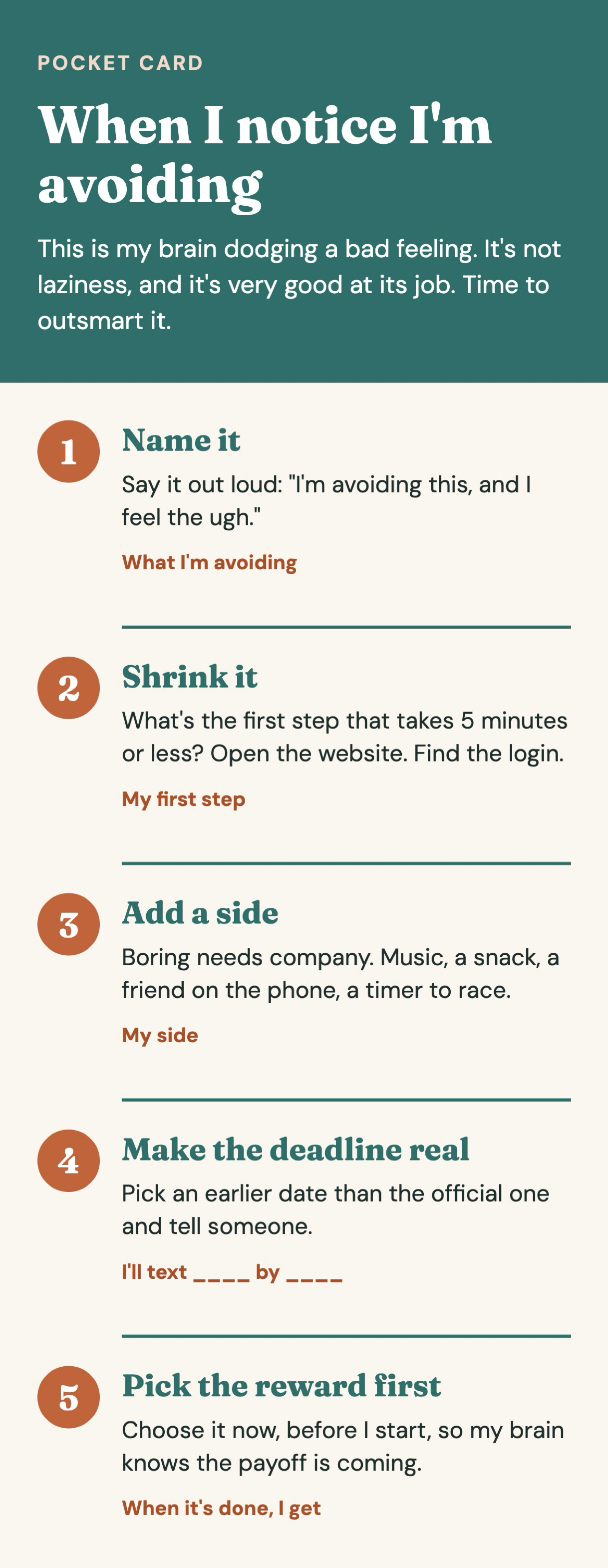
I made a little card to keep on your phone. It has five steps, with a line to fill in under each one.
Name it. Say out loud, “I’m avoiding this, and I feel the ugh.”
Shrink it. Find the first step that takes five minutes or less. Open the website. Find the login.
Add a side. Boring needs company: music, a snack, a friend on the phone, a timer to race.
Make the deadline real. Pick a date earlier than the official one and tell someone.
Pick the reward first. Choose it before starting, so the brain knows the payoff is coming.
And at the bottom, a box for the day it doesn’t work: restart in 15 minutes. One skipped task is not a verdict.
Laundry, with the card
Here’s how the card handles a pile of laundry.
Name it: “I’m avoiding the laundry, and I feel the ugh.”
Shrink it: Carry the basket to the machine. That’s the whole first step, and starting the washer counts as a win.
Add a side: Save a podcast, show or playlist just for laundry, and have a snack ready. Start right after something that’s already happening, like lunch.
Make the deadline real: Pick a start time and tell someone. “I’m starting a load at 4, and I’ll text you when it’s in the washer.”
Pick the reward first: Choose it before starting, so “not now” gets a payoff.
Then time it. Most of laundry is waiting on machines, so the hands-on part is usually much shorter than the dread suggests, and seeing the real number written down makes the next load easier to start.
So, can the clothes clean themselves?
No. I checked. But the real question was never about the clothes. It was about why a smart, capable person can’t make themselves do something with no real deadline, and the answer is that the brain needs the task to feel real, interesting, or both.
You can build that on purpose. Name the avoidance, shrink the first step, bring a side dish, make the deadline real, and pick the reward first.
If you’d like help building your own version, I’d love to hear from you at susanpagorcoaching.com.
About Susan Pagor
Susan Pagor is an ICF-certified ADHD and executive function coach who works with adults, college students, and teens. She helps clients build practical, judgment-free strategies for getting started, staying organized, and following through, so the “not now” tasks finally get their turn. Susan coaches virtually and in person from her office in San Carlos, California.
You may also like…