Why Visual Timers Are Game-Changers for ADHD Brains (And How to Actually Use Them)
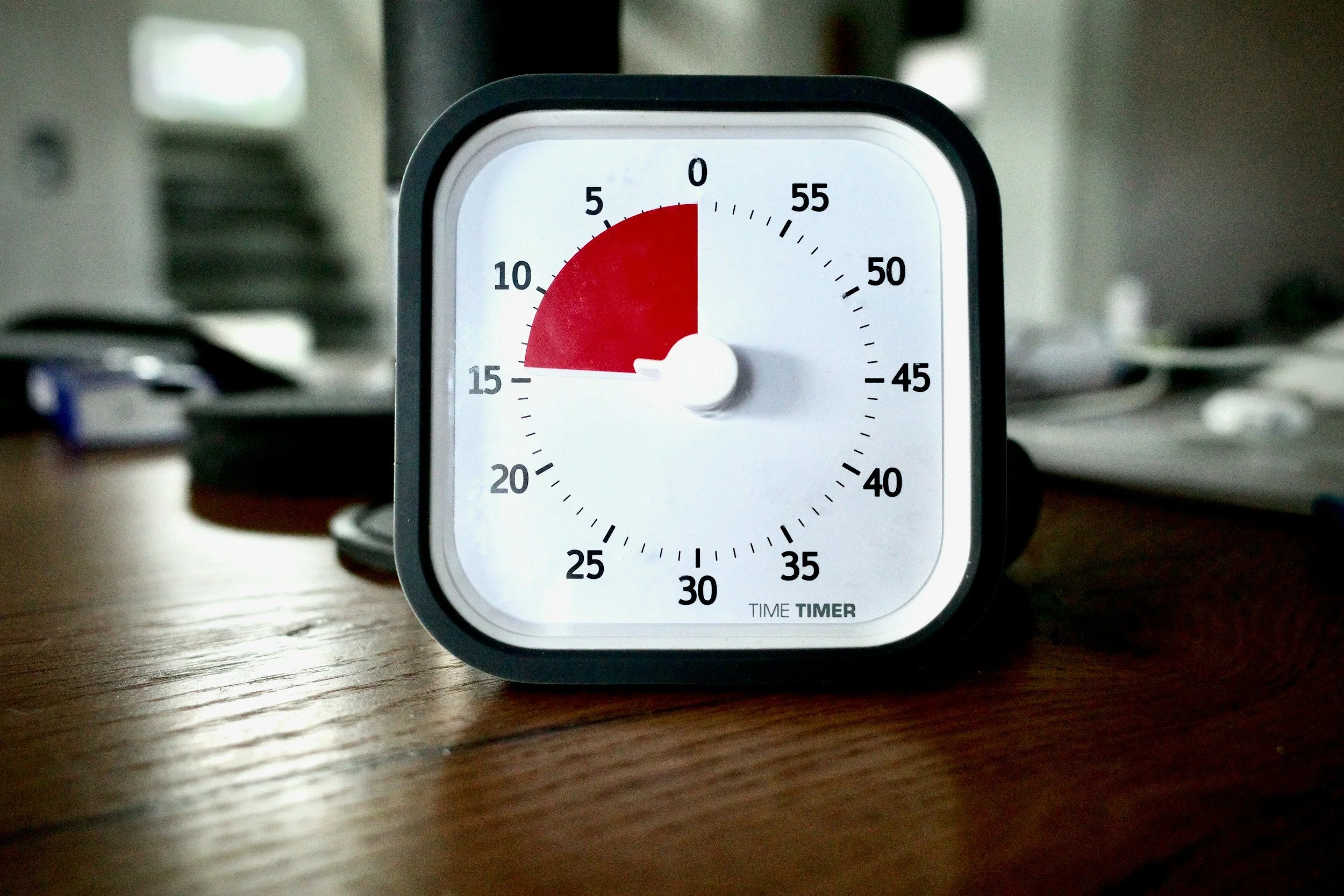
Picture this: You're staring at a task you really don't want to do. Maybe it's organizing your receipts for taxes, or finally tackling that closet that's been haunting you for months. Your brain screams "NOPE!" and suddenly you're reorganizing your desk drawers instead—a task you also don't want to do, but at least it's not that task.
Sound familiar?
Here's what I've learned through years of coaching adults with ADHD (and living with it myself, along with three of my four kids): The problem isn't that we're lazy or undisciplined. The problem is that our ADHD brains experience time completely differently than neurotypical brains do.
And when you can't see time, it's really hard to work with it.
That's where visual timers come in—and I'm not exaggerating when I say they've been one of the most powerful tools in my coaching toolkit.
The ADHD Brain and the Time Problem
Let me tell you something that changed everything for me: ADHD brains don't have a broken "time sense"—we just literally perceive time differently.
Jessica McCabe, creator of the How to ADHD YouTube channel, explains that time horizons for those with ADHD tend to be much shorter, with events existing either "now" or "not now"—and anything "not now" can feel like it doesn't exist at all.
Research on children with ADHD has identified specific problems with time and timing that affect daily routines, homework, school work, and social relations. But here's the thing: this doesn't magically go away when we become adults. We just get better at feeling bad about it.
I can't tell you how many clients come to me saying "I know I should be able to just start the thing, but I can't." They're stuck in what feels like an impossible paradox: they want to do the task, they know they need to do the task, but their brain just... won't.
This is where visual timers become your secret weapon.
What Makes Visual Timers Different
You might be thinking, "I have a timer on my phone. How is this different?"
Here's the key difference: visual timers make time visible. They externalize something that's invisible and abstract (time passing) into something concrete you can actually see (a shrinking disk, a disappearing bar, a changing color).
For ADHD brains that struggle with working memory and time perception, this is like turning on the lights in a dark room.
Visual timers physically show time passing, such as through a colored disk that gradually disappears as minutes pass, creating a concrete visual representation that can serve as an external working memory aid.
I discovered this with my own kids first. We'd battle every morning about getting ready for school. "Five more minutes" meant absolutely nothing to them. But when I set a Time Timer—the one with the red disk that disappears—something clicked. They could see their time running out. The arguments stopped because the abstract became concrete.
Then I tried it for myself. And honestly? Game changer.
How I Use Visual Timers (And How My Clients Do Too)
Getting Started on Tasks You're Avoiding
This is the big one. This is where visual timers have literally saved me from myself.
Here's what I do: When I'm facing a task my brain is rejecting (hello, insurance paperwork), I set a visual timer for just 10 minutes. Sometimes even 5.
That's it. Just 10 minutes.
Why does this work? Because my brain isn't committing to finishing the entire horrible task. It's just committing to 10 visible minutes. I can see those 10 minutes ticking down. When my brain tries to wander ("maybe I should check my email first..."), I can glance at the timer and think, "Nope, only 7 minutes left. I can do anything for 7 minutes."
The visual countdown creates urgency without panic. Visual timers can create a sense of urgency instead of waiting for deadlines to creep up, offering a healthier form of urgency that can help you start tasks before they become time crises.
How to implement it: Start ridiculously small. If 10 minutes feels too long, try 5. Or even 3. The goal isn't to finish the task—it's to prove to your brain that you can start it. You can always set another timer after the first one ends. (And you probably will, because getting started is usually the hardest part.)
Using Your Time Intentionally (Not Just Letting It Evaporate)
One of my clients recently told me, "I sat down to quickly respond to one email, and three hours later I'd reorganized my entire inbox but hadn't actually done any of my real work."
We've all been there.
Visual timers help you timebox—which is a fancy way of saying "this task gets exactly this much time, and then I'm done."
Before you start any task, decide: How much time do I want to give this? Then set your visual timer for exactly that amount.
This works for tasks you might hyperfocus on (like my client with her inbox) and tasks you might avoid. The timer keeps you honest either way.
How to implement it: At the start of your work session, write down your tasks and assign each one a specific time allotment. "Email: 20 minutes." "Project proposal: 45 minutes." "Organizing desk: 15 minutes." Set your visual timer for each block and actually stop when it goes off (or at least pause and consciously decide to continue).
The Pomodoro Method (With a Visual Twist)
You've probably heard of the Pomodoro Technique—work for 25 minutes, break for 5, repeat. It's popular for good reason.
But here's the secret: it works even better with a visual timer.
The Pomodoro technique provides a clear measurement of time and rewards you for your progress by enforcing structured work and break periods. When you can actually see the 25 minutes counting down, it's easier to stay focused.
When my brain starts wandering mid-Pomodoro ("Oh, I should text my friend back..."), I glance at the timer and see "12 minutes left." It's much easier to tell my brain "we can do that in 12 minutes" than "we'll do that later" (which we both know means never).
For people with ADHD, shifting into focus mode may take a bit longer, so the traditional 25-minute work time may not be enough, while others may need shorter task times followed by brief breaks.
How to implement it: Don't feel married to 25 minutes. I have clients who do 15-minute Pomodoros, and others who do 45. Start with whatever feels doable and adjust from there. The key is the visual feedback loop: see the time, stay focused, take the break, repeat.
Making Transitions Less Painful
Transitions are brutal for ADHD brains. We either can't stop what we're doing (hyperfocus), or we can't start the next thing (avoidance/paralysis).
Visual timers create a bridge. Set your timer for 10 minutes before you need to transition. Place it where you can see it while you're doing your current activity.
The visual countdown mentally prepares you for the shift. Research found that using a visual timer helped students with autism spectrum disorders transition smoothly from computer time to work time because having a visual timer allowed the students to see how much time was left.
How to implement it: If you need to leave for an appointment at 2:00, set your timer for 1:50. If you're working on something and have a meeting at 3:00, set a timer at 2:45. The visual cue helps your brain start wrapping up and preparing for the switch.
Building "Time Wisdom"
Here's something powerful that happens when you use visual timers consistently: you start to develop what I call "time wisdom."
You learn how long things actually take. Not how long you think they should take, or how long you hope they'll take—how long they really take.
This is huge. Because once you know that getting ready in the morning actually takes you 45 minutes (not the 20 you keep telling yourself), you can plan accordingly.
How to implement it: For one week, time everything. How long does it take you to shower? Make breakfast? Drive to work? Respond to emails? Write it down. You'll be shocked—I guarantee it. But this information is gold for planning your days realistically.
Finding the Right Timer for Your Brain
Not all visual timers work for all brains. Here's what to consider:
Physical vs. Digital:
Some people need a physical object they can touch and move around. Others prefer the convenience of an app. I use both—a Time Timer on my desk for work, and apps when I'm out and about.
Silent vs. Ticking:
Some timers tick, some are silent. I find the ticking incredibly helpful (rhythmic, steady reminder), but one of my clients says it drives her absolutely batty. Know yourself.
Size and Placement:
Your timer needs to be visible enough that you can glance at it without interrupting your flow, but not so big or bright that it becomes a distraction.
Popular options my clients and I love:
Time Timer (the classic red disk—perfect for visual learners who need to see time disappearing)
Cube timers (great for preset times—just flip to the side you want)
Hourglass timers (satisfying to watch, completely silent, tactile)
Apps like Visual Timer, Focus Keeper, or Llama Life (portable, customizable, great for when you're not at your desk)
Try a few different types. What works for your friend or your partner might not work for you, and that's completely normal.
The Bottom Line
Visual timers won't magically cure time blindness. You'll still sometimes lose track of time. You'll still occasionally hyperfocus and miss things. That's part of having ADHD.
But visual timers can make time visible. And when time is visible, it becomes manageable.
They can help you:
Actually start tasks you've been avoiding
Use your time intentionally instead of watching it evaporate
Build boundaries around both work time and break time
Reduce the anxiety of "how long have I been doing this?"
Develop realistic expectations about how long things take
Most importantly, visual timers work with your ADHD brain instead of expecting your brain to magically become something it's not.
Start small. Pick one situation where time feels slippery—maybe it's getting started on work in the morning, or limiting your social media scrolling, or making sure you actually take breaks. Try a visual timer for that one thing for a week.
See what happens. Adjust. Try again.
Remember: your difference is your genius. Your ADHD brain isn't broken—it just needs different tools. Visual timers might be exactly the tool that makes the difference.
Ready to discover more strategies that work with your unique brain? I specialize in ADHD and Executive Function coaching, focusing on practical, innovative approaches tailored to how you actually think and work—not how someone else thinks you "should." Let's figure out what will work for you. Learn more about coaching with me.
References
Ptacek, R., Weissenberger, S., Braaten, E., et al. (2019). "Clinical Implications of the Perception of Time in Attention Deficit Hyperactivity Disorder (ADHD): A Review." Medical Science Monitor, 25, 3918-3924.
McCabe, J. (2024). How to ADHD: An Insider's Guide to Working with Your Brain (Not Against It). Rodale Books.
"Focus! Learn the Pomodoro Technique for ADHD." The ATTN Center, September 24, 2025.
"How to Wind the Pomodoro Technique for ADHD." Psych Central, September 1, 2021.
Hermansson, E., Janeslätt, G., Granlund, M., & Tinglev, A. (2018). "Effectiveness of time-related interventions in children with ADHD aged 9–15 years: a randomized controlled study." European Child & Adolescent Psychiatry, 27, 329-342.
"Breaking the Cycle: How Visual Timers Can Help Adults with ADHD Overcome Procrastination." Time Timer, October 16, 2025.
"Why ADHDers need an ADHD timer for time management and productivity." Llama Life, March 5, 2024.